Sep 8, 2026|
Beyond the Chatbot: How JD Health Is Bringing AI Into Doctors’ Everyday Work
A doctor reviewing a complex case may need to search through medical literature, check the latest clinical guidelines, assess drug interactions, interpret test results and bring together years of patient information, often under significant time pressure.
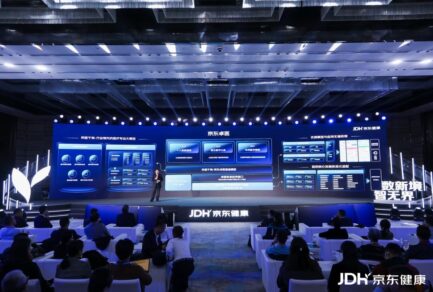
This is where Zhiyi (知医) comes in. Developed by JINGDONG Health (also known as JD Health), Zhiyi is an evidence-based AI assistant built specifically for healthcare professionals. Its Chinese name fittingly brings together the ideas of “professional knowledge” (知) and “doctor” (医).
Launched in January 2026, Zhiyi brings AI into the everyday workflow of doctors in China, supporting clinical decision-making, medical research, patient management and other professional tasks. It has integrated more than 50 million medical papers, clinical guidelines and authoritative journal resources, together with information from more than 160,000 pharmaceutical product instructions. The platform has already served over one million doctors and supported more than 20 million clinical decision-making interactions.
From Finding Information to Understanding the Evidence
Searching for medical information is one thing. Turning it into useful evidence for a particular patient or clinical situation is much harder.
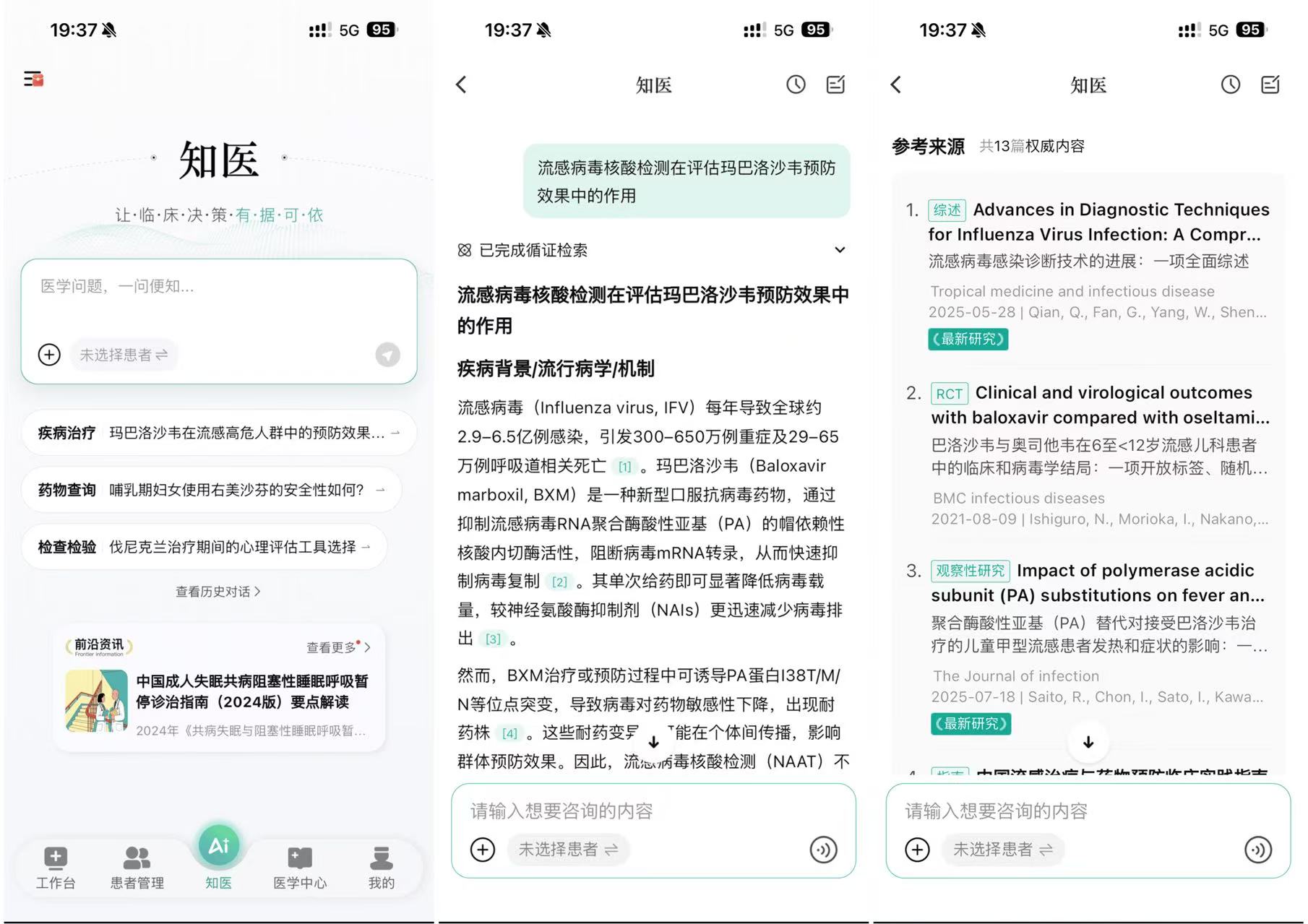
Zhiyi is designed to help doctors move beyond simple search. Its Deep Thinking mode can break down complex questions, assess different levels of evidence and provide structured references for doctors to consider, including in cases involving multiple conditions or medications.
A good example is oncology. Zhiyi has integrated the China Anti-Cancer Association (CACA) Guidelines for Holistic Integrative Management of Cancer, which cover 29 cancer types and 72 diagnostic and treatment technologies. By making this body of specialist knowledge searchable and actionable through AI, Zhiyi can help doctors access relevant evidence when they need it, rather than requiring them to navigate lengthy reference materials separately.
Zhiyi also offers more than 200 medical calculators, covering areas such as disease assessment, risk stratification, medication dosage and cardiovascular risk, with AI providing evidence-based interpretation of the results. Its research assistant extends these capabilities into academic work, supporting literature reviews, patient education materials and presentations.
The aim is simple: reduce the time doctors spend navigating information so they can focus more of their expertise on understanding the patient and making clinical decisions.
Making AI Fit the Way Doctors Actually Work
Clinical information rarely arrives as a perfectly structured prompt.
It may be a laboratory report, prescription, medical image, PDF document or information collected across previous consultations. Zhiyi’s multimodal capabilities allow doctors to upload and analyze different types of clinical materials, reducing the need for manual entry and page-by-page review.
More importantly, Zhiyi is designed to show doctors where its conclusions come from. Its dynamic evidence-location capability can identify the original text supporting a clinical point, allowing doctors to trace AI-generated information back to the underlying evidence.
That distinction matters in healthcare. A useful medical AI assistant should not simply produce an answer; it should help a professional understand the evidence behind it.
When “Sounds Right” Isn’t Good Enough
Generative AI can produce convincing answers. In medicine, however, convincing is very different from reliable.
JD Health has therefore built dedicated evaluation systems around Zhiyi. Its MedScope framework evaluates AI outputs across evidence quality, content accuracy, appropriate expression and practical usefulness, supported by evaluation sets spanning 46 major clinical specialties.
A separate MedSafety framework evaluates 26 categories of high-risk medical scenarios, including medication contraindications and complication warnings. High-risk outputs that cross defined safety boundaries do not pass the evaluation.
This reflects an important principle behind JD Health’s approach: AI is there to support medical professionals, not to replace their experience, judgment or responsibility.
One AI Foundation, Different Healthcare Supports
Zhiyi is part of a broader AI healthcare architecture JD Health has been developing.
Underneath it is Jingyi Qianxun (京医千询), JD Health’s proprietary medical large language model. Rather than positioning the model itself as the final product, JD Health is applying its capabilities to specific healthcare workflows, including evidence retrieval, clinical support, patient follow-up and medical research. Zhiyi is one example of how that underlying AI capability is translated into a practical professional tool.
On the patient-facing side, Dawei (大为), JD Health’s AI doctor, applies AI to another part of the healthcare journey. JD Health has also launched more than 1,500 AI agents based on specialist doctors, alongside solutions developed for hospitals and specific disease areas.
Together, they illustrate a broader strategy: rather than building one AI assistant for every healthcare problem, JD Health is developing specialized AI tools around the needs of different users and healthcare scenarios.

Taking Medical AI Beyond Major Hospitals
Perhaps one of the most meaningful tests of medical AI is whether it can make high-quality tools more widely accessible.
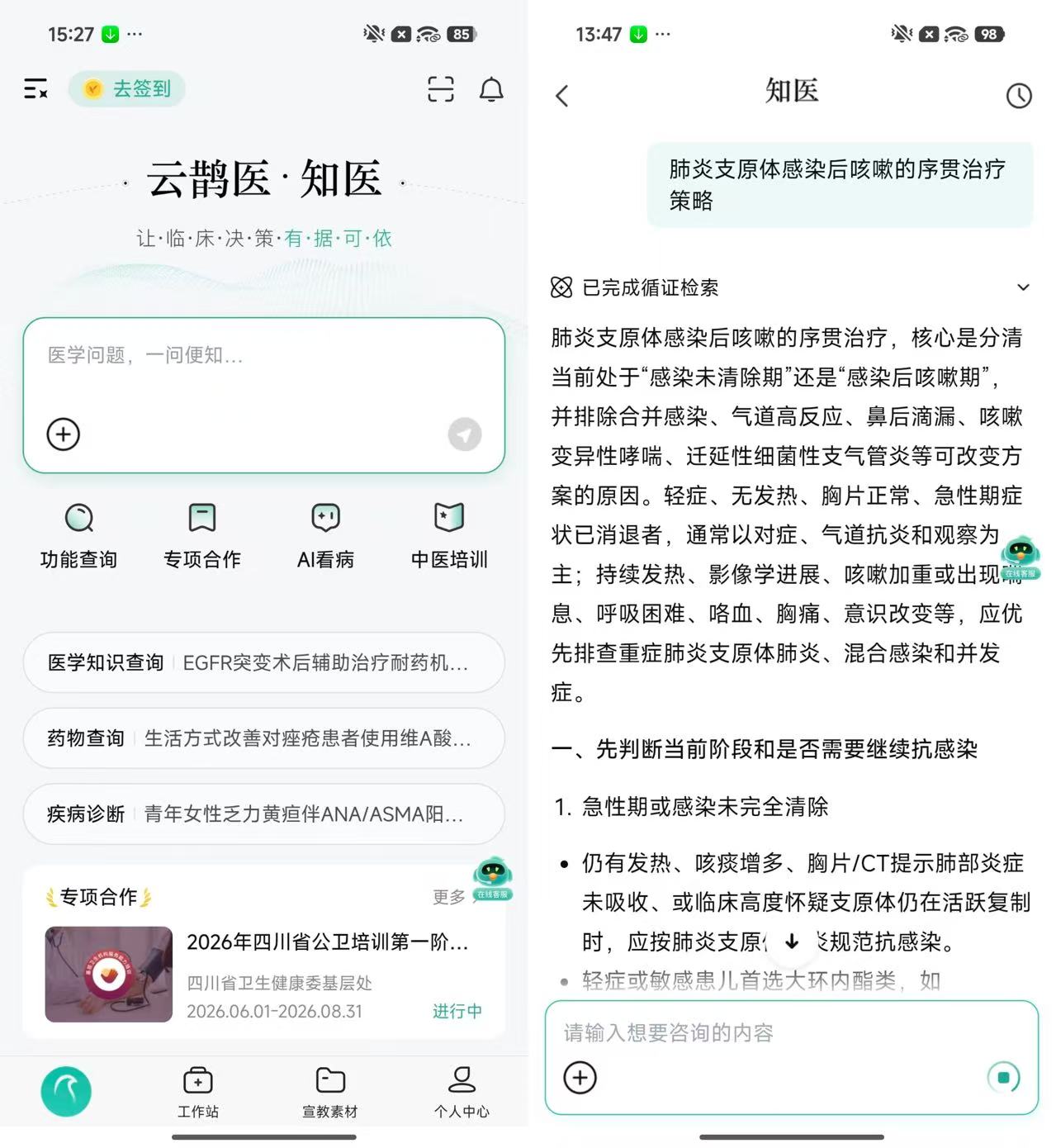
In August, JD Health formed a strategic partnership with PICA Health (Yunqueyi), one of China’s largest digital platforms serving primary-care doctors. Zhiyi has been integrated into the PICA Health app, making its upgraded capabilities, including Deep Thinking, medical calculators and research assistance, available free of charge to the platform’s registered primary-care doctors serving. PICA Health connects around three million registered primary-care doctors serving China’s grassroots.
The significance is not simply putting AI into more hands. A doctor working in a smaller community can use the same AI tool to access medical literature, clinical guidelines and evidence-based decision support that would otherwise be more difficult or time-consuming to obtain.
And this is where JD Health brings another capability into the picture: supply chain infrastructure.
JD Health’s pharmaceutical supply chain reaches more than one million villages in China, while same- or next-day delivery coverage has reached 87.1% across county-level areas covered by its network.
This creates an interesting connection between medical intelligence and healthcare access: AI can help doctors find and interpret the right evidence, while supply chain capabilities can help turn a clinical decision into access to the medicines and healthcare products patients need.
Building AI Around Healthcare, Not Healthcare Around AI
There is no shortage of discussion about how powerful the next generation of medical AI models will become. JD Health’s experience with Zhiyi suggests that model capability is only part of the equation.
Healthcare AI also needs trusted medical evidence, safety mechanisms, integration into real clinical workflows and a way to reach the doctors and patients who can benefit from it.
That is why Zhiyi is particularly illustrative of JD Health’s broader approach. The technology begins with a medical large language model, but extends into authoritative resources such as the CACA Guidelines, professional tools for doctors, partnerships such as PICA Health, patient-facing services such as Dawei, and JD Health’s wider healthcare and supply chain infrastructure.
Doctors’ experience, judgment and responsibility remain at the center. The role of AI is to help those capabilities go further by making trusted knowledge easier to reach, complex information easier to navigate and everyday clinical work more efficient.
The more meaningful question for healthcare may therefore be not whether AI can become a doctor, but how AI can help every doctor do more for every patient.
(vivian.yang@jd.com)
Mar 26, 2026|
JD.com Leads 48 Partners to Launch Quality Alliance to Elevate China’s Pet Care Ecosystem
China’s pet industry is entering a new chapter of sophisticated growth. As pets are increasingly cherished as vital family members, the demand for premium products and ethical services has reached an all-time high. On March 18th, 2026, JD Pet, a division of JD.com (a.k.a JINGDONG), joined forces with 48 leading organizations—including Royal Canin, Myfoodie, Pure Natural, Boehringer Ingelheim, Ringpai Pet Hospital, AllianzJD and PICC (People’s Insurance Company of China)—to establish the Pet Industry Quality Ecosystem Alliance and lead this transformation.
The initiative represents the most ambitious collaborative effort in the history of China’s pet sector. By bridging the gap between manufacturing, retail, healthcare, and insurance, the Alliance aims to dismantle industry barriers and create a transparent, high-standard experience for pet owners nationwide.
A Vision for Value-Driven Excellence
The Chinese pet market has evolved from a niche segment into a multi-billion dollar powerhouse. However, rapid scaling requires a shift in focus from mere volume to long-term quality. In a joint open letter, the Alliance members emphasized a move away from price-driven competition toward “value-driven excellence.”
“Our industry is built on love and the sanctity of life,” the Alliance stated. “As professionals, we have a collective responsibility to ensure that every pet receives the care they deserve and every owner enjoys total peace of mind.”
Six Pillars of Commitment and Quality Growth
To support this high-quality development, JD Pet linked up with all partners to introduce six major initiatives designed to reshape the pet care experience:
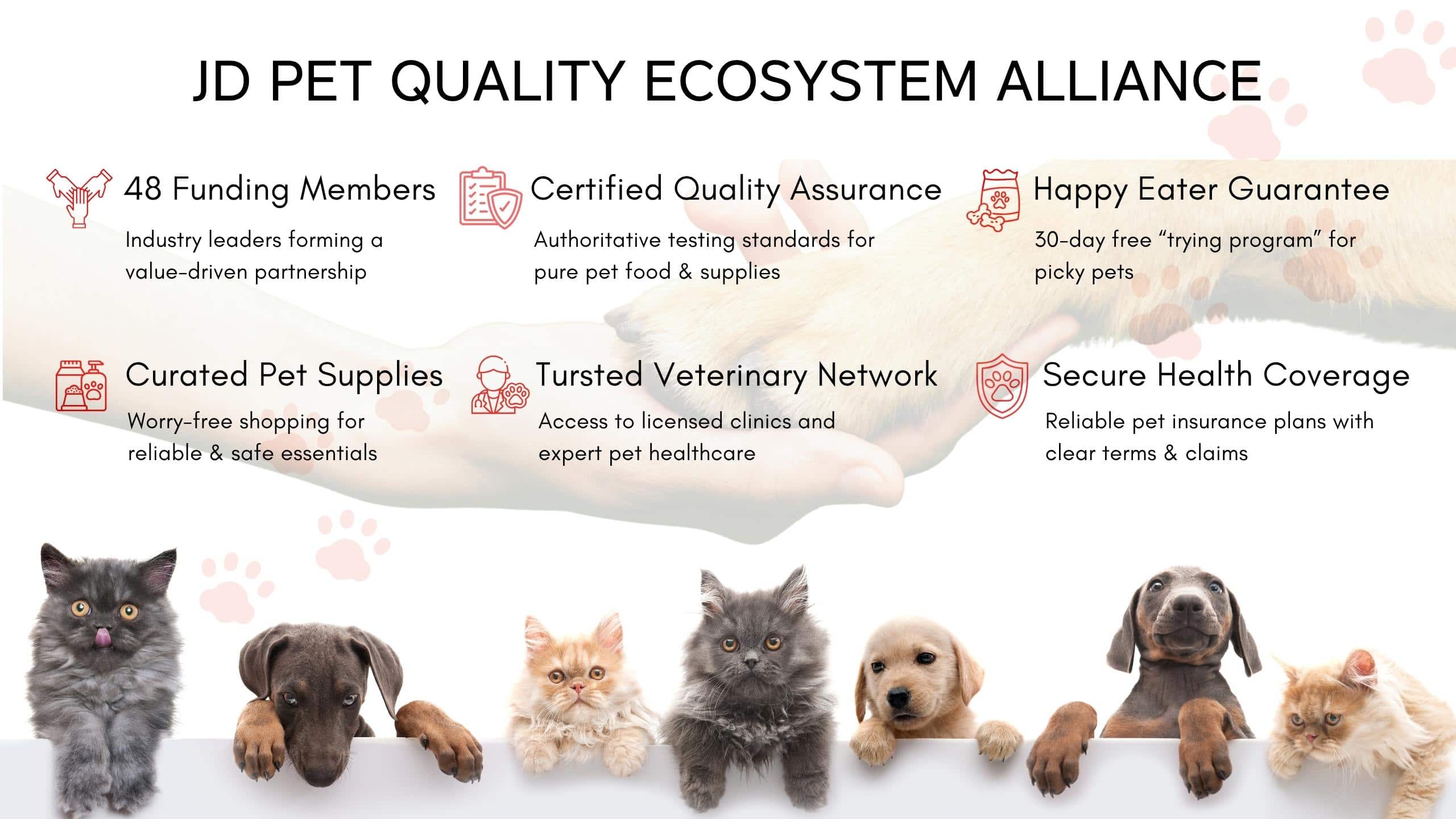
- Guaranteeing Food Safety and Quality: JD Super, the supermarket division, is anchoring consumer trust by introducing a bold “100x Compensation” pledge for its ” gold-label” selective self-operated pet food. Should a product’s ingredients be found inconsistent with its label or fail to meet national safety standards, JD Pet will compensate the customer 100 times the purchase price. Simultaneously, JINGDONG Cross-border, the import business platform, is leveraging its global sourcing network to curate products from 21 countries that strictly adhere to international AAFCO and IFS standards, ensuring 100% authenticity from the source.
- Standardizing the Live Pet Trade: To address the traditional lack of transparency in online pet purchasing, JD Pet is launching the “Internet Enterprise Standard for Pet Trading.” This comprehensive framework establishes rigorous protocols for health certifications, genetic identification, and ethical sourcing. By standardizing the process from selection to delivery, the initiative ensures that every “furry friend” arrives at its new home healthy and verified.
- Enhancing Specialized Logistics: Recognizing that transportation is a critical touchpoint for animal welfare, JINGDONG Logistics is utilizing its robust and specialized infrastructure to build a dedicated pet transport network. This includes the pilot launch of “Pet Houses” for comfortable transit, the use of custom climate-controlled vehicles, and the deployment of professional care teams trained to monitor pet well-being and minimize stress throughout the journey.
- Integrating Professional Healthcare Services: JD Health is centralizing care through a specialized “Consult-Test-Treat-Insure” ecosystem. The platform provides immediate access to licensed veterinary consultations, convenient home testing kits, and the industry’s most extensive range of pet medications. To ensure consumer confidence, JD Health is also introducing a “Refund if Ineffective” policy for self-operated medications. Furthermore, JD Health is synchronizing these digital tools with a network of over 11,000 professional offline pet hospitals, facilitating a seamless transition from online light-symptom consultations to offline specialized treatment.
- Advancing Transparent Insurance Solutions Innovation in financial protection is being led by JD Insurance, which is launching a 365-day New Pet Medical Insurance plan featuring direct settlement at 1,000 hospitals and 100% reimbursement ratios. Beyond this specific product, JD.com is joining forces with major insurers—including PICC, CPIC, PingAn, AllianzJD, and ZhongAn—to issue a collective call for the entire industry to develop insurance products that truly align with pet owners’ needs, moving away from complex clauses and difficult claims processes.
- Expanding Holistic Life Services to support pet owners in their daily routines, JD Home Serviceshas expanded its specialized offerings to multiple cities. These services include professional in-home feeding and medical-grade deep cleaning specifically designed for pet-owning households. By standardizing these high-frequency services, JD is ensuring that pet care is integrated seamlessly into a modern lifestyle.
The Pet Industry Quality Ecosystem Alliance is a true commitment. By aligning the interests of manufacturers, healthcare providers, and retailers, JD.com is fostering a marketplace where quality-focused brands can thrive, and consumers can shop with absolute confidence. We believe that when we protect the well-being of pets, we protect the warmth and happiness of the homes they live in.
(vivian.yang@jd.com)
 From AI Models to the Physical World: Highlights from JDDiscovery 2026