Nov 3, 2026|
Making Intelligence Operational: JD.com CEO Sandy Xu on Turning Enterprise AI into Business Value
Editor’s Note: How can AI move beyond experimentation to deliver meaningful results for businesses and customers? In the FII Institute’s Enterprise AI Impact Report, JD.com CEO Sandy Xu shares her perspective on embedding AI into real-world operations, connecting decisions across business processes, and building open ecosystems for innovation. Originally published in the report in October 2026, the following article explores how JD.com is putting these ideas into practice across retail, logistics, healthcare and industrial supply chains.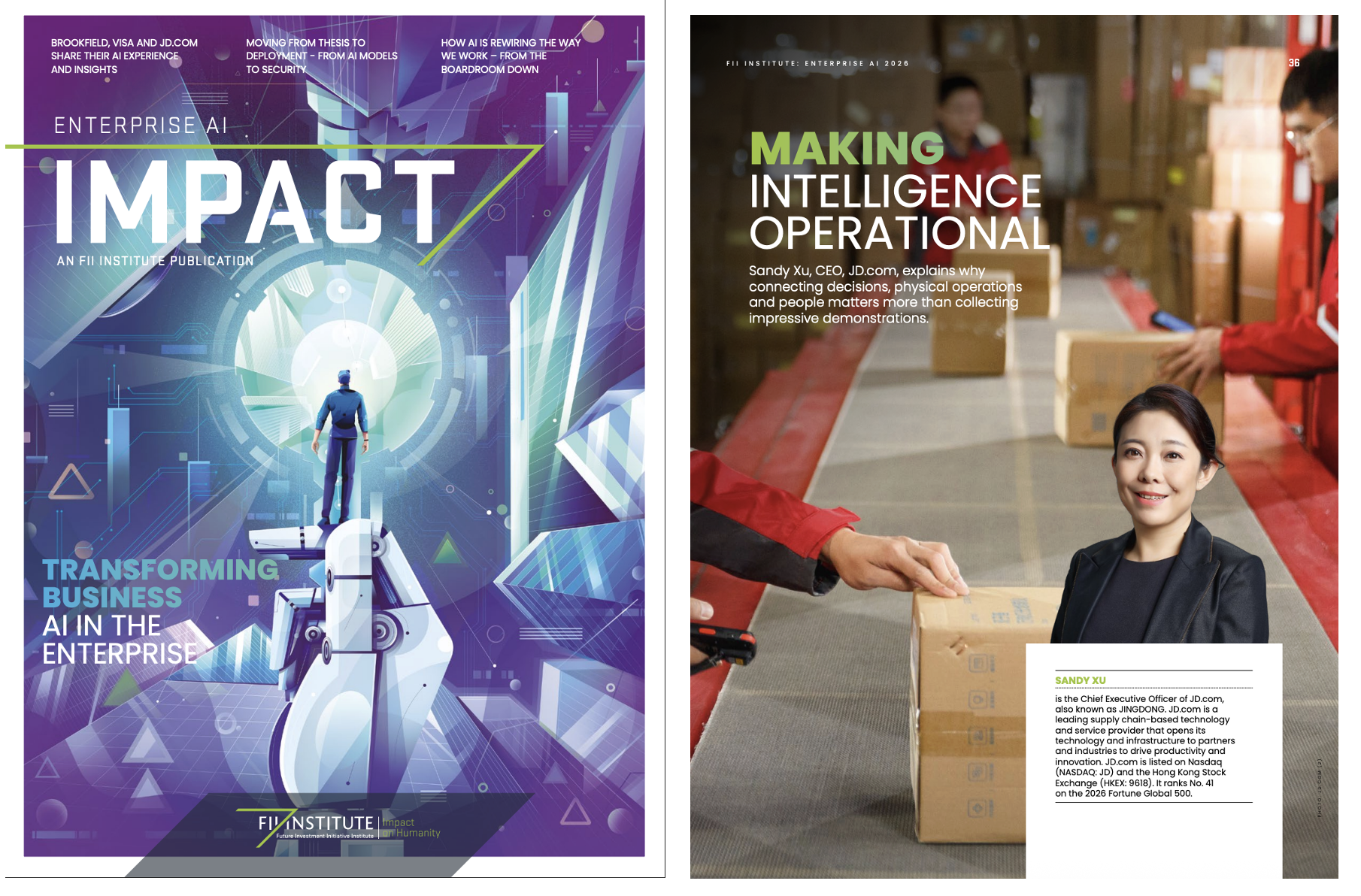
To get a parcel moving through a logistics network, you need to have a series of decisions operating as one. Stock must be positioned, goods picked and sorted, transport assigned and the final journey planned. Tinkering around the edges – such as making one decision faster – can help with the process. But connecting those decisions can change how the whole operation works – for the better.
That’s the distinction Sandy Xu, CEO, JD.com, draws between AI experimentation and enterprise capability. The company’s starting point is the same question it asks of other investments in its business. Does the technology improve the customer experience, lower costs and increase efficiency?
“It becomes an enterprise capability only when it is embedded in real business processes and consistently delivers measurable results,” Xu says.
JD.com has applied AI across more than 3,000 scenarios in businesses spanning retail, logistics, healthcare, industrial supply chains and food delivery. But as every major organization is finding with their AI adoption, the challenge is to connect that activity to useful operational change.
Where Decisions Become Actions
Xu sees particular potential where information meets the physical world. Language models already help JD.com employees work with information in functions like customer service and finance. It’s a little trickier in logistics and industrial operations, which add equipment, inventory and people to the equation.
“AI often creates the greatest value not where there is the most information, but where information can ultimately be translated into decisions and actions,” she says.
A model’s understanding becomes commercially relevant when it helps determine what to buy, where to put it or how to fulfil a customer’s request.
In logistics, JINGDONG Logistics’ MetaBrain connects AI with planning and decision-making across the network. Xu said it has been used in more than 1,000 logistics and supply chain scenarios, with the objective of moving from improving individual processes towards forecasting and coordination across connected operations.
AI can also be used in physical environments thanks to increasing innovation in embodied AI, in relatively controlled environments, including warehouse navigation and moving goods – with Xu expecting its role to expand further as perception, reasoning and execution improve.
Learning the Industry
AI excels at general knowledge, but industrial procurement shows we also need more specialized AI capabilities built for specific industries and use cases. Products have detailed specifications, and data standards can differ depending on which business or supplier you’re working with.
So JINGDONG Industrials has developed JoyIndustrial, an industrial supply chain foundation model combining AI with accumulated product and supply chain knowledge.
Xu says the business used more than 70 AI agents across its value chain in the first half of 2026, including applications in product data, matching supply and demand, procurement and fulfilment.
Yet the larger opportunity, Xu argues, lies in joining work that has previously been fragmented. Marketing content can be generated more efficiently within one department, while it’s possible now to use AI to connect customer demand to product selection, inventory forecasting and fulfilment.
All that of course requires changes within the company itself, too, from responsibilities to information flows. Xu draws a parallel between AI and electrification: businesses gained more when they redesigned production around a new capability than when they simply substituted equipment within an existing process.
Her argument for AI suggests that organizations need to examine what work should become once information and decisions are able to move differently.
Measuring the Difference
At JD.com, there has been a gradual process of connecting and upgrading operations, bringing individual workflows into a more integrated whole, says Xu. Leaders have to decide who owns a process, how teams cooperate and what governance applies when an agent participates in work spanning several functions.
It would be easier to just install another tool rather than improve those relationships, but the relationships determine whether the technology becomes part of how the business actually runs.
“Good enterprise AI should ultimately be visible in financial performance, operational metrics and customer experience,” says Xu.
For her, model specifications, consumption measures and the number of tools deployed are insufficient proxies. For the operator, useful measures include inventory turnover, fulfilment efficiency, costs and workforce productivity. For the customer, the question is whether needs are better understood and service improves. For partners, it is whether participation becomes easier and creates opportunities for growth.
Together, those measures connect internal productivity with external value.
But despite the potential of AI, Xu is clear that people are part of that calculation. JD.com trains frontline employees in robot maintenance and repair as automation spreads through its operations.
Xu’s view is that repetitive work can shift towards technology while employees develop technical skills and focus more on judgement and service – but that transition will require investment in capabilities, as well as equipment.
Building Open Ecosystems
Xu expects the next stage of enterprise AI to depend increasingly on open ecosystems that bring together different types of expertise.
JD.com’s JoyInside embodied AI platform, powered by its proprietary JoyAI model, is one example. Through an open ecosystem, it is working with nearly 200 brands across appliances, robotics, healthcare, toys and other categories to bring AI into a wider range of hardware and real-world applications.
JINGDONG Industrials’ Baichuan Initiative takes a similar approach, bringing together industrial companies and partners to share capabilities and explore new AI applications across industrial supply chains.
Both show why applying AI in specialized environments requires more than technology alone. Domain knowledge, relevant data and real-world operating experience often sit across different organizations. Partnerships can bring these complementary capabilities together, helping AI move into real-world applications and enabling businesses to create value together.
It’s a lesson Xu believes other enterprise leaders can learn from: if you understand the business problem, connect the people and processes needed to solve it, you can then measure the result. AI becomes consequential when it changes the decisions that move products, fulfil needs and create value – but the real test starts when the demonstration ends and the operation is underway.
(press@jd.com)
Oct 19, 2026|
JINGDONG Industrials and Partners Launch Alliance to Strengthen Global Industrial Supply Chains
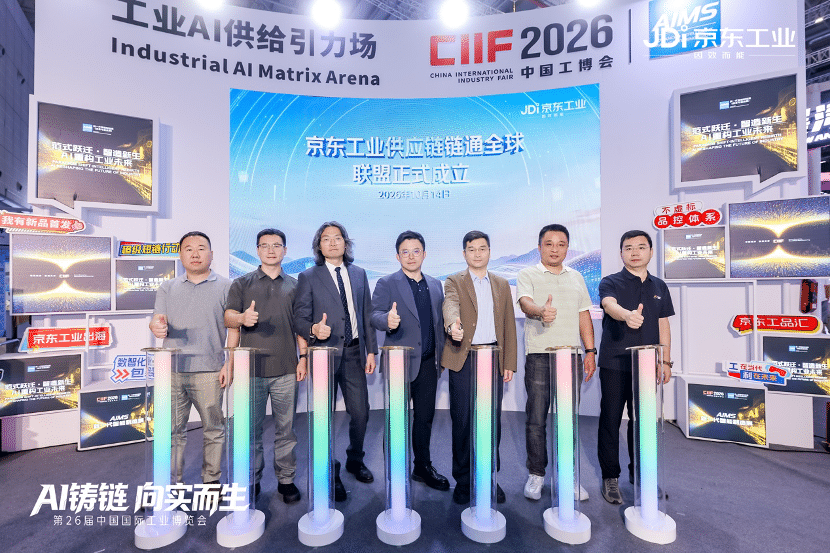
JINGDONG Industrials (JDi), JD.com’s industrial supply chain business, and industry partners launched the JDi Global Supply Chain Connectivity Alliance on October 14 at the China International Industry Fair in Shanghai. The initiative aims to connect manufacturers, customers and service partners through digital technology and international fulfilment networks, helping businesses improve sourcing and delivery across markets.
The alliance builds on JINGDONG Industrials’ growing international operations. The company has established a presence in Thailand, Indonesia, Malaysia, Vietnam, Hungary, Brazil, Saudi Arabia and the UAE, serving approximately 100 enterprises across sectors including automotive manufacturing, electronics and new energy. Its services support local and multinational businesses, as well as Chinese companies expanding internationally.
Local fulfilment is a key part of this approach. In Thailand, JINGDONG Industrials combines local sourcing, cross-border procurement and locally stocked inventory to meet different production needs. Orders fulfilled from stock held in Thailand can be delivered in two to three days, while cross-border orders typically take 25–35 days. These options help customers balance delivery speed, inventory needs and procurement costs.
At the accompanying international business forum, partners discussed how technology and closer collaboration could improve supply reliability. Chen Mo, Spare Parts Procurement Manager at Minth Group, highlighted the importance of connecting fragmented local demand with dependable global supply. He noted that Minth Group has worked with JINGDONG Industrials in Europe to address gaps in local sourcing and fulfilment, connect procurement systems, and reduce costs in selected product categories.
JINGDONG Industrials is also advancing the development and application of AI agents for customs clearance and warehousing, aiming to reduce routine administrative work across markets with different requirements. Alongside support for large enterprises, the company is extending its services to small and medium-sized businesses in international markets.
Through continued investment in local warehousing, distribution, and operations teams, JINGDONG Industrials aims to give customers and partners more reliable access to industrial products and services. The alliance provides a platform for further collaboration on these practical supply chain needs.
(vivian.yang@jd.com)
 Gome App Launches JD Super’s First-Party Consumer Goods