Topic

JD Doubles Subsidies for Its Holiday Workers to RMB 200M Yuan

by Yuchuan Wang

In the ninth consecutive year providing nonstop delivery during the Chinese New Year holiday, JD Logistics will further increase its subsidies for frontline employees such as couriers and warehouse staff working during the holiday to RMB 200 million yuan, doubling the RMB 100 million yuan initially announced in January.

“My parents are in Shijiazhuang. I decided to stay [in Beijing] where I work when I saw the surge of COVID-19 cases in my hometown,” said Kunlin Yin, a JD courier in Beijing.

As more and more Chinese people choose to stay where they work for Spring Festival holiday to reduce the possibility of being infected with COVID-19, JD’s data has shown a sharp increase in remote orders — where the sender and recipient cities differ. From the Dec. 8-20 on the lunar calendar, remote orders increased 55% YOY.

This year, JD expanded its CNY delivery policy such that customers in 30 provinces, municipalities and autonomous regions, nearly 300 cities and 1,500 counties and districts can receive orders during the holiday as fast as usual.


(yuchuan.wang@jd.com)

Photo Gallery: This Week at JD (January 30 – February 5)

Authorized by the Guozijian Museum, JD and Amazon Kindle launched an exclusive JD super box for the upcoming Chinese New Year. The super box includes the classic Kindle Paperwhite, a specially designed Kindle cover featuring traditional Chinese calligraphy of Guozijian (国子监), which is the highest education and education administration body of ancient China since Emporor Yang Guang (569-618AD) of Sui, a one-month card for Kindle Unlimited, a Kindle 2021 diary notebook, plus Chinese couplets and CNY red envelopes.


Chinese smartphone maker OnePlus has set up special demonstration areas at 41 JD Home stores in cities including Beijing, Shanghai, Nanjing and Hangzhou. Based on the cooperation, JD will give OnePlus access to its livestreaming technology and data resources, as well as one-hour delivery service. Meanwhile, OnePlus will provide sufficient supplies, brand training, and promotion support to the stores.


A customer in Shijiazhuang is typing the verification code to pick up his order from the smart delivery vehicle

JD has rolled out a smart delivery vehicle in Shijiazhuang, Hebei province, one of the latest epicenters of the COVID-19 outbreak. The vehicle can be loaded with 24 parcels at a time. Couriers would disinfect the vehicle before it leaves the delivery station. It plans its own route based on autonomous driving technologies, and travels unsupervised to a designated pick up point. Once it arrives, it would make a phone call to the customer and send a message with a verification code to retrieve the orders.


JD Pet, together with charity organizations including NPI, a Shanghai-based charity organization, Beijing Animal Adoption Day, as well as pet product brands including Mars, My Foodie, Nature Bridge and more have donated 10,000 kg pet food for homeless animals.


Tonic Snacks Trending as Chinese New Year Gifts

by Vivian Yang

Searches of gift boxes of tonic products have tripled since the beginning of JD’s New Year Grand Promotion (Jan 8 until now) compared with the same period last month, and ready-to-eat tonics are gaining popularity among Chinese consumers, said JD Health’s Tonic Industry Data Report 2020.

“Healthy & tonic snacks have become a new trend in this traditional industry,” a staff of the tonic business department of JD Health pointed out, noting the traditional way of taking Chinese tonics involves tedious cooking processes such as steaming, boiling, stewing and more, which deters many young people. Now customers can find and shop for many ready-to-eat tonics on JD.com, such as steaming bird nests with sugar, fish maw, Ejiao (colla corii asini) cake, and dried Chinese wolfberry tea. These small-bag packed instant tonic products are convenient to eat and carry, and serve as nice New Year gifts for families and friends.

Hot-selling ready-to-eat Ejiao cakes on JD.com

JD’s data shows that remote orders of tonic products grew more than 35% from last month. Many people living in first-tier cities have started to send tonic gift boxes to their families in third or fourth-tier cities since this January. Gift boxes with assorted tonics are the most popular, noted a JD Health representative.

Diving into the specific products, Chinese consumers’ top tonic choices include bird nests, health tea, cordyceps sinensis, fish maw and ginseng. Female consumers account for more than 70% of sales for bird nests and fish maw, consumers under 30 years old fancy health tea, and those above 45 years old prefer cordyceps sinensis and ginseng.

In terms of regional differences, people from southern China, especially those living in the Yangtze River Delta and the Pearl River Delta spend more on raw ingredients and prefer to cook them in the traditional ways for fine nourishment, whereas people from northern China and northeast China show more willingness toward the ready-to-eat offerings, according to the data from JD Health’s report.

The Yangtze River Delta covers three provinces of Jiangsu, Anhui, and Zhejiang, as well as the city of Shanghai. The Pearl River Delta consists of nine cities in Guangdong province, including Guangzhou, Shenzhen, Shantou and the others.


(vivian.yang@jd.com)

JD Provides Closed-Loop Services for Gold Trade

by Hui Zhang

JD launched an online “Gold Safe” business leveraging its logistics advantages, which is the first of its kind through online platforms in China, to provide one-stop services for gold buying, deposit to selling.

Thanks to JD’s Mini Storage service, which enables individuals and small enterprises to store their goods in JD’s warehouses securely and cost-effectively, consumers can directly store gold products into JD’s warehouses after purchasing from JD and they can take out their gold whenever they want. Their gold products will be delivered by JD Logistics. Consumers can select 90, 180 and 360 days for the storage period.

For gold investors, finding a reliable, stable and efficient agent to sell their gold has always been a problem, although there are many channels to sell gold, from small street stores and pawnshops to gold stores and banks.

Based on the market demand, JD took advantage of its supply chain to develop a gold buyback business in 2018. With its technology advantages, JD cooperated with China National Gold Group and Shandong ZhaoJin Group, to make it possible for consumers to not only buy gold online, but also sell online. Due to the simplicity of online operation, the online gold buyback model has been recognized by consumers and merchants, and has maintained rapid development in the past two years. In January 2021, sales of JD’s gold buyback business increased by 300% YOY.

“Purchasing gold online is becoming popular among consumers, and physical gold investment is gaining more attention. The launch of JD’s “Gold Safe” business will help make it easy and convenient for consumers to invest in gold and further improve the gold trade,” said a spokesperson from JD’s gold business.

As a precious metal for reserves and investment, gold can be considered a barometer of global economic stability. Data from the China Gold Association shows that in the third quarter of 2020, gold bullion and gold coin sales increased by as much as 66.73% YOY.


(zhanghui36@jd.com)

JD Launches Amazon Kindle Super Box with Guozijian

by Ling Cao

As the Chinese New Year (CNY) is approaching, authorized by the Guozijian Museum, JD and Amazon Kindle have launched an exclusive JD super box.

This super box includes the classic Kindle Paperwhite, a specially designed Kindle cover featuring  traditional Chinese calligraphy of Guozijian(国子监),which is the highest education and education administration body of ancient China since Emporor Yang Guang (569-618AD) of Sui, a one-month card for Kindle Unlimited, a Kindle 2021 diary notebook, plus Chinese couplets and CNY red envelopes.

JD Super Box is a program launched by JD, aiming to produce special boxes by collaborating with brands, designing interesting products to satisfy customers’ different needs.

The Kindle cover reflects Chinese tradition of encouraging people read more books, while Guozijian was a dreaming college for youngsters then to pursue higher education.

A representative from JD’s office products department said, “Guozijian represents a profound cultural and educational element of China, which is in line with the spirit of reading more books. That’s why Amazon Kindle and JD chose to work with Guozijian Museum to deliver this product.”

Leveraging e-commerce and operation experience, Amazon Kindle and JD also found that when purchasing a Kindle, customers care about the appearance very much. The two companies began discussing and preparing for the super box in mid-December last year. With CNY around the corner, both companies have added couplets and red envelopes to the set as best wishes.

During JD’s last June 18 Grand Promotion, over 50 global brands participated in super box program, including Adidas, Karl Lagerfeld and Swisse.


(ling.cao@jd.com)

“Adding Color to Holiday Memories”: JD FMCG Omnichannel President

by Kelly Dawson

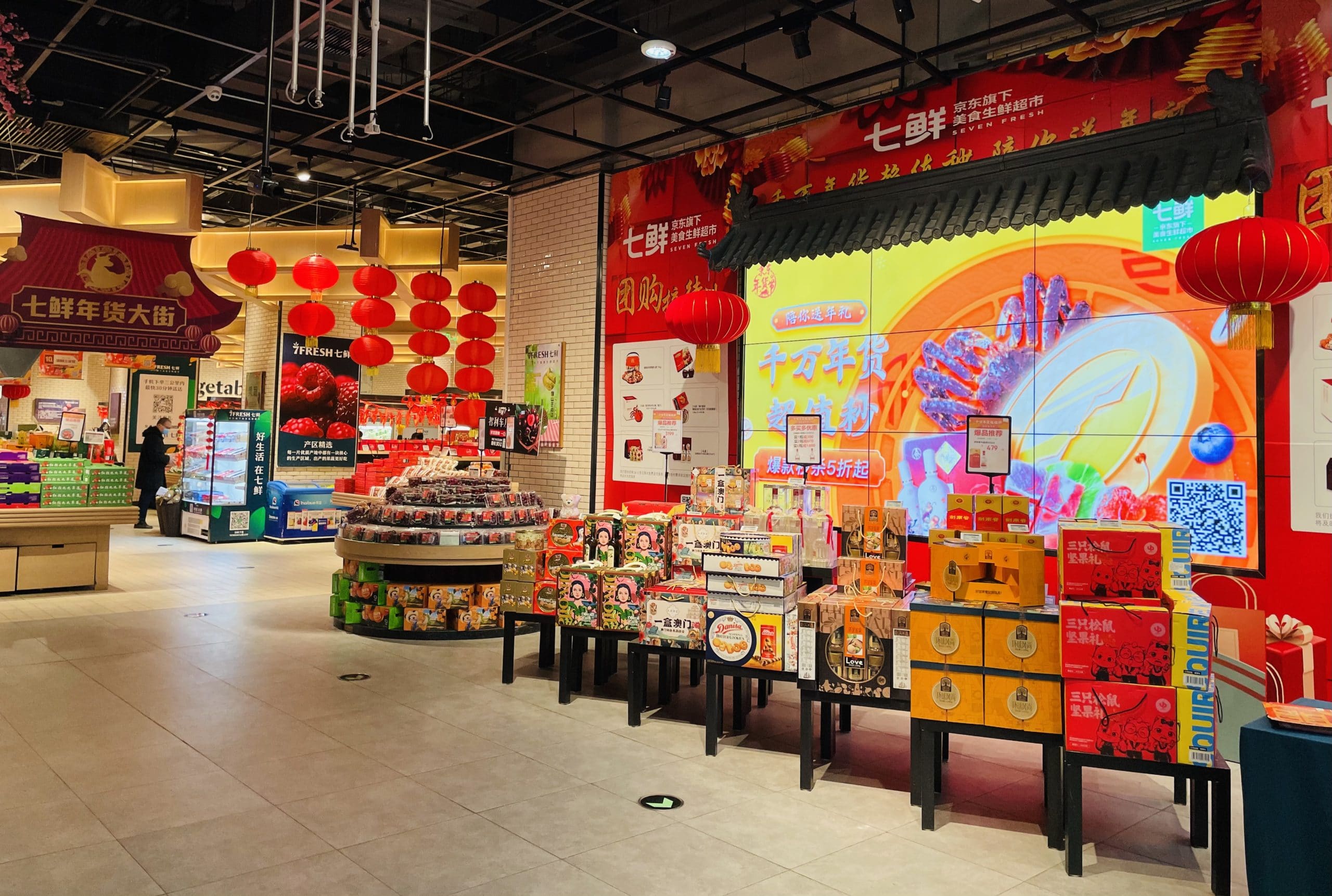
Amid a recent uptick in COVID-19 cases, many Chinese are preparing to stay in the cities where they work during the upcoming Chinese New Year holiday. For those who are yearning for the tastes of home, JD’s omnichannel through its JD Super and SEVEN FRESH is providing not only fresh ingredients but a wide range of Chinese New Year-ready meals for customers, including ready-to-cook meal gift boxes and meal packages.

“This Chinese New Year will be a special experience for many Chinese people and we hope that JD’s service can add color to their holiday memories,” said Carol Fung, president of JD’s FMCG Omnichannel division, which encompasses JD’s online supermarket JD Super and offline supermarket chain SEVEN FRESH.


JD’s ready-to-cook, ready-to-eat foods and fresh products will make celebration preparations “faster and easier,” Fung said. “Customers can receive their products even on the first day of the holiday, thanks to the nonstop delivery of JD Logistics. [They] can receive the products they need, even on the eve of Chinese New Year in as fast as 30 minutes.”

JD Super collaborates with many local supermarkets and chain stores including Walmart to make this instant delivery service possible. SEVEN FRESH will also provide delivery services, with delivery provided by JD Express for customers who purchase in stores.

SEVEN FRESH, as one of JD’s key omnichannel retail initiatives, was launched in 2018 and has positioned itself as a high-end offline retail supermarket. Each offline store has thousands of products covering food, fresh, FMCG and more.


(kellydawson@jd.com)

In-depth Report: JD’s Big Data: Help Shaping Real Economy

by Ling Cao

When making a purchase online, some consumers may opt to filter search results by top sales performance – this is a simple expression of a consumption trend. A more complex version is a report which considers multiple factors. For example, as Spring Festival is approaching, a report has revealed trends that C2M (Consumer-to-Manufacturer), which uses big data to provide advice to brands about how to create products to better meet market demand, house decoration and local specialties are popular. This report could also serve as a guide for consumers who haven’t bought New Year gifts yet. In China, there were 83 billion parcels circulated in 2020, according to the State Post Bureau, equal to 59 parcels per person per year on average. This massive parcel volume has formed a unique database that let consumption trends emerge.

The JD Big Data Research Institute, an open and professional platform based on the big data of JD.com, has generated around 120 reports in 2020, three times higher than that of 2017, when it was just launched. The Spring Festival report is just coming out by working with Chinese financial media Jiemian.

Hui Liu, chief data officer of the Institute shared, “Unlike peers, JD’s core advantage regarding data is the long value chain. For example, starting from a customer searching on JD’s website, to purchasing a product, to last mile delivery and after sales, the integrated process can be connected as part of JD’s big data.” Liu added: “The integration and complexity allow us to produce accurate customer profiles and consumption trends. Ultimately, we can know the why and how behind a transaction.”

Hui Liu (center) with JD colleagues

How to create a report

There are always interesting trends on people’s radar. Ahead of last Chinese Valentine’s Day (Qixi七夕, July 7th on the lunar calendar, falls on July 25th last year), the institute found that when it comes to adult, COVID-19 may have impacted their purchase choices, but certainly hasn’t caused consumer interest to wane. The report was popular, and was even reported on by leading marketing media, The Drum. The outlet wrote: JD’s data “saw dramatic changes in related search keywords when people in China went into lockdown as it drove a huge increase in demand for contraceptives and stimulated long-distance partners’ desire to make purchases for their counterparts from afar.”

Liu shared, “Qixi is the best time to discuss such a topic, and even to take advantage of it since people are usually too shy to talk about it. Leveraging the timing and our big data ability, we can show the society the culture of this category in China. And we also have industry data showing that we have a comparative advantage in this category such that we can represent the online consumption of adult products in industry.”

Liu shared four general steps for generating a report: 1) Forecast insights by reading relevant materials and interviewing business teams at JD; 2) Consider holding a workshop with internal and external experts. 3) Reflect the insights in the task of data selection, 4) Proof or override the forecast insights based on data analysis. If the data don’t agree with the initial forecast, the team will find new insights and conduct further research.

“Generally, it’s important to forecast insights at first, otherwise insights will be buried in the massive amount of data,” added Liu.

The institute is focused on much more beyond the basic process of putting together a report. Fei Lu, senior researcher at JD’s Big Data Research Institute was responsible for making the adult products report. He shared an innovative way to combine objective data analysis with a subjective questionnaire, which could make the result more persuasive. For example, data can reflect certain sales performance, while the questionnaire can reflect reasons behind the purchase. Lu also shared another creative way of making cross analysis, especially comparing two items which seem unrelated. Lu said, “Most of the efforts are in vain but there is still the possibility of an unexpected surprise.”

For instance, last Chinese National Day holiday was a time to test whether China’s offline consumption had recovered amid the pandemic. As a major online platform, JD also planned to work on a consumption report. Lu cross-analyzed many different aspects of data. For example, Lu has put Hubei’s (Hubei’s capital city Wuhan was the  epidemic epicenter of the COVID-19 outbreak in China last year) local food sales performance together with third party tourism data, which unexpectedly showed that the increased growth rate of the food may be related to population mobility. Taken together, this implied that Hubei’s consumption growth rate had recovered to the level before the epidemic. The data was used in several domestic media reports.

The institute has consistently provided insights during COVID-19, finding for example, that the younger generation took on much more responsibility; JD has become one of the most trusted platforms by customers; and consumption upgrading and rationalization are carried out simultaneously. These trends could provide a direction and insight in the industry.

Lu added: “Our internal business team came to us after we published the adult products report, and said it could be good material for business development purpose. I felt like this is also part of the value of our job.”


Why launch the institute

Right now, the institute not only produces consumption-related reports, but also has expanded to cover to industrial or regional economy research, providing broader value. This is far beyond the objectives when the institute was first established. “In the beginning, we found that JD’s R&D team had already used big data to make valuable analysis for internal use, such as to determine the most active customer group,” explained Liu. “This inspired me to consider how to expand its external value.”

There were several objectives at first: 1) Response to media requests, supporting reporting with certain trends; 2) Response to business team’s needs, making vertical industry reports covering electronics, home appliance, FMCG(fast moving consumer goods), as well as baby and maternal products; 3) Work with external think tanks or institutions to produce meso-economic and industrial reports, such as a rural e-commerce analysis; and 4) Visualize the data in a command center during important promotions such as the 618 Grand Promotion, and introduce the findings to a multitude of internal and external stakeholders.

Imported products consumption highlights exhibited at the command center during 11.11 Grand Promotion in 2020

Combine strength of JD and external experts

Fei Dong, senior researcher at the Institute shared, “JD’s own data mostly represents an online sales trend, while we will consider whether it’s thorough enough to reflect a macro trend. That’s why we are willing to expand cooperation with external experts, such as universities, and enterprise-level think tanks at companies such as Tencent and Ctrip.”

One case was an employment report produced by JD and Maimai, China’s workplace social networking platform. Under the program, both companies provided data to complement each other.

Experts, such as professors at universities, have the advanced knowledge architecture, and a more far-reaching understanding of the industry, as well as better analysis methodology. When looking at certain topics such as lower tier market penetration, JD will invite them for a workshop, to discuss the macro trends in society.

For example, JD and Renmin University of China have cooperated on an environmental protection program, which targeted to research how green awareness will impact customers’ consumption. Specifically, by combining the university’s methodology with JD’s data, the team labeled two groups of products. Group A showed green related labels in the product description page, and group B was normal. The differentiation in sales, customer profile and more were compared.

Dong added, “The Institute focused more on consumer related reports before, but as we have recruited colleagues with different expertise backgrounds, as well as cooperated with more and more external experts, we have more confidence to do industrial forecasts.”


Future direction

Liu pointed out the importance of providing value for brands and partners at the industrial level. He shared an example of how regional economy research can effectively help brands better manage their business and set goals. Take Chongqing for example. JD will analyze how Chongqing’s local specialties perform in and outside the region, and compare the customer profile of local residents with the national average. This can help brands better understand the industry and know whether customers have awareness of certain products, so as to judge where the potential opportunities are. Liu added, “JD is designing an interaction system, enabling partners to search for regional economy development rankings in China, with specific profiles for a particular province, and performance for certain products.”

Liu also added, “We hope the institute can not only provide value to brands, customers, industries, but also to young talent. Going forward, we are thinking of open up part of our data and case studies to them, providing value for their academic research. In the same time, they can bring fresh thinking to us.”

Consumption trend reports or vertical industry analyses are mostly dealing with micro economies. JD hopes to extend from data analysis to deep case studies, producing industrial-level and meso-economics-related reports, on topics such as the development of the industrial internet. JD will expand its retail-centered analysis to service and technology, extending the value of big data to broader areas.

Liu concluded, “In fact, data is just a foundation. It’s all about how technology can shape the real economy.”


(ling.cao@jd.com)

JD Big Data: Three Trends from this CNY Grand Promotion

by Ella Kidron

A recent report published by the JD Big Data Institute revealed a handful of trends observed during the Chinese New Year grand promotion.

Fei Lu, senior data analyst at the Institute, said: “Spring Festival is one of the most important festivals in China. It is also an important shopping season, but there were some concerns that reduced travel to hometowns would cause a consumption contraction. Our data, however, shows demand staying strong with growth driven in new sectors.”

Here are three trends worth noting:

1. New definition of “home”

Home is a vital ingredient of the Chinese New Year. Ordinarily, many Chinese people will travel from the city where they work to their hometowns to celebrate CNY with their big families. A new wave of COVID-19 cases across several provinces in January has prompted many consumers to opt to stay put rather than travel.

But the saying “home is where the heart is”, rings true as consumers in the big cities rush to send gifts home, and hometown friends and family are eager to send a “taste of home”. This is one of the reasons for a spike in “remote orders” (orders where the sender and recipient city differ). Interestingly, the highest number of such remote orders coming from Beijing head to Hainan.

Looking more closely at CNY Grand Promotion orders, rice, flour, oil, alcohol and other necessities have seen a 1-2-time increase YOY. In addition to products, sales of services such as laundry, healthcare, auto, pet services and more have increased 6-10 times compared with the same period last year (according to the lunar calendar).

2. Driving “new” areas of consumption

The concept of staying put in the place of work instead of traveling has meant increased consumption in new categories. Comparing the consumption structure for CNY last year and this year, it is possible to see that pet life, maternal and child, personal care and education and books consumption as a proportion of the total is more significant. Consequently, with a reduction in travel and visits, the alcohol and gift category expenditure as a proportion of consumers’ total CNY spending has gone down.

Consumption remains vibrant, especially for high quality, high-priced goods like gold and silver, milk powder and luxury goods. “CNY is a very good time for brands, especially for the release of new products, which always lead the consumption trends,” said Lu. “During 2021, the number of consumers buying new products on JD’s platform increase as much as during Singles Day. This is what we defined as the ‘Rebuilding of Consumer Confidence’.”

3. Young consumers set the trend; the rest follow it

Micro-demand has triggered multiple opportunities for brands to capture trends. For example, during this CNY Grand Promotion, the famous traditional dish Buddha-Jumps-over-the-Wall has seen explosive demand in southeastern provinces, with sales increasing 320% YOY, an old soda brand, Arctic Ocean, increasing 207% and Hanfu (traditional Chinese dress worn in ancient times), which has become very popular in the last few years, increasing 78%. Shanghai consumers are keen on bird’s nest and Ferrero chocolates, while footbaths in Wuhan, Hubei province increased by 115%. Consumption of electronic firecrackers in Beijing more than doubled compared with the same period last year.

Lu said: “JD’s consumption data can provide an accurate reference for brands to release new products, control the pace and position marketing.  In the chaotic, post-epidemic era, consumers need a strong and powerful guarantee and leader, instead of being blindly conservative and cutting back on expenditure.”


(ella@jd.com)