By Ella Kidron
For the last few weeks, many people residing in China have been living their entire worlds online. With many supermarkets closed or out of stock, people have turned to e-commerce for their daily produce needs. With schools closed for the foreseeable future, cloud technology-based online classrooms have been set up. With corporate employees working from home, entire corporate IT systems have seemingly been reconfigured overnight to support everything from “clocking in” to hosting video conferences. In fact, many of China’s big cities have seemingly adjusted to not just relying on online for convenience, but to living their lives online.
This raises the question – in this online-heavy world, is there in fact a role for brick-and-mortar stores? After all, they’ve been closed for a few weeks now in order to reduce human-to-human contact, and life has generally kept on.
The answer is, yes, absolutely – in this online-heavy reality, brick-and-mortar stores not only have a role, but an important one. They are the place to experience products, to immerse oneself in a world of possibility, and to be inspired. Today’s brick-and-mortar stores are the modern “wonderlands” of our time.

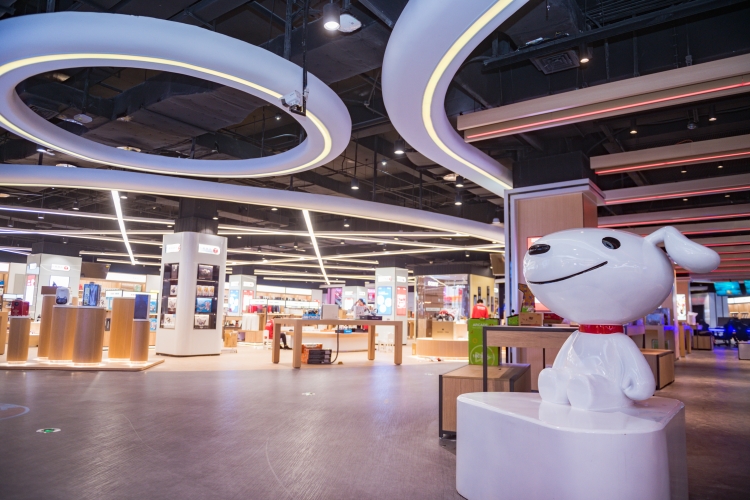
JD E-Space in Chongqing, China
Wonderland in Chongqing
Rewind a couple months ago to last December. It’s a foggy late Thursday morning in Chongqing, a city in Southwest China that is around the size of the entire country of Austria. Home to over 30 million people, Chongqing is increasingly becoming known as a “Wang Hong” city, or a popular city amongst China’s internet celebrities. Slightly off the beaten path – there are small restaurants and shops, nearby – and yet visible from hundreds of meters away from any direction, is JD E-Space, a 50,000 square-meter megastore operated by JD.com. Opened during Singles Day (November 11th), its claim to fame is that it offers consumers the chance to try virtually everything in the store – from go-karts, to washing machines and more.
Upon entering, JD E-Space looks like a modernized version of a traditional electronics store one might find in the United States, say, BestBuy – there are separate sections for each brand to display their products, roughly arranged by category. But to say that the experience is even remotely similar would be a gross oversimplification of what E-Space has to offer.
The middle of the first floor has a small race track, and to its side, are go-karts and Segway-like devices fully charged and ready to go. A shop assistant is helping a young boy get set up in one of the go-karts while talking to the boy’s father about the different models of the Ninebot go-kart. Ninebot is a homegrown Chinese brand that caters not only to the young, but also the young at heart. The brand, which has traditionally been sold entirely online, chose JD E-Space as its very first offline location.
This makes sense for a few reasons – the first is that in recent years, the retail industry has been experiencing an interesting shift where brands who may have once started as small offline kiosks are instead opting to make their debuts entirely online. In this day and age, being a purely online player can be hugely advantageous for brands as it helps them to minimize overhead costs by not having to pay for large store spaces while also minimizing the risks that selecting the wrong location will result in less than ideal foot traffic. Not to mention, reducing the risk of being severely impacted by an unexpected epidemic outbreak like the current coronavirus.
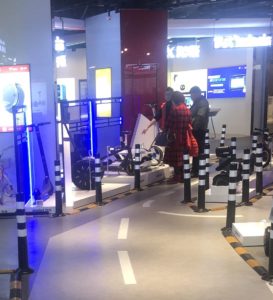
Designated go-karting area in JD E-Space
Real Interaction
What’s missing, however, when a brand opts to go this route, is the real interaction that consumers have with their products before deciding to make a purchase. E-Space takes this a step further, allowing customers to not only drive on the designated race track, but in fact, all over the store, with the supervision of the Ninebot sales assistant who is an expert not only on the types of product specs one might expect to be able to find online, but also on what it really feels like to use the devices, tips and tricks on how to overcome the initial, deep seated fear that might come with a handle-free Segway-like device, and for the brave, how to safely do a few tricks.
Observing for several minutes, and even eventually summoning enough courage to give it a try, it becomes apparent how this type of interaction with a product might actually tip the scales in favor of a purchase, regardless of whether or not there was originally a plan to do so. The beauty of E-Space’s omnichannel solution is that should today be the day to buy a go-kart, simply scanning a QR code on the product can make this dream a reality. But there is no need to take the product home. JD Logistics can deliver it same-day or next-day, regardless of whether or not the customer’s home is near E-Space. In some cases, the customer might live in another city entirely, but thanks to a highly integrated supply chain, this type of delivery speed is not unfathomable.
Not far from the go-karts are drones which can be flown in an enclosed space, and digital cameras. All of the cameras on display face a mini-display of the city of Chongqing to practice shooting photos. Often one of the frustrations people express after buying something like a digital camera is that despite the initial eagerness to purchase it, it often ends up on a shelf collecting dust. Why? Because after buying it, they’ve realized they don’t have the slightest clue as to how to use it.
Recognizing this, E-Space put increased emphasis on creating not just an after-sales program, but a closed loop experience covering try, buy, study and share. Consumers can come back to E-Space again and again for tutorials and tips on how to make the most of their new cameras through courses offered by experts. E-Space’s thinking in this respect is to inspire confidence about how to use these products, so that consumers will be more eager to share their photos with friends, and even encourage them to also get on board with a new camera. This covers the virtual sharing aspect. But what about offline? Just to the side of the camera section is a museum grade digital gallery where the staff of E-Space select certain outstanding photos to display on a rotating basis.
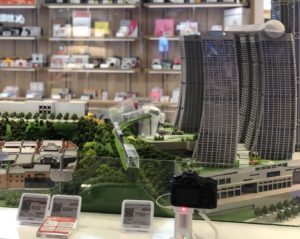
Digital camera testing zone in JD E-Space
The Experience Economy
The second floor offers a familiar sight – a row of massage chairs. It is noon, and 30 or so massage chairs located nearby the escalator are all in use for a combination of post-lunch nap and relaxation. The group of elderly occupying the chairs seem to know each other – those who are awake are chatting excitedly in Sichuanese – they appear to be regulars to E-Space, cementing the fact that this is not just an ordinary store, but a social space.
It caters to all age groups, too. On the weekend, professional video gaming teams will come to E-Space to compete, inviting an engaged audience of young people, many of which who also play the game, and others who are just fans. There is even a small studio to do a popular “Zhi Bo” or “livestreaming” session. For the less gaming-inclined, the beauty area offers tutorials on beauty products and hair styling sessions (which include use of the latest, highly popular Dyson hair dryer), while the bakery area offers courses in bread-making, cookie baking and more.
The second floor of E-Space, which is arranged by product, rather than by brand, is more like what might be found in a traditional electronics department store, but that is by design. The focus is on being able to compare different brands’ versions of similar products. The TV section is a great example. For the most discerning of consumers, rows and rows of TVs of similar size from different brands are on display for detailed, in-depth comparison.
Equally, E-Space serves as an education space for consumers to learn more about products or types of products they might not have had a great grasp of before. For those who are less technically inclined, the difference between LCD and OLED TVs might not be immediately apparent, especially when simply scrolling through reviews about the crisp, rich colors of an OLED display – the words on the page might not be enough to convince someone of the need to upgrade to the admittedly more costly OLED display. When placed side by side with LCD, however, as is done in E-Space, the difference between the two becomes immediately apparent. That’s not to say that LCD is unbearable – simply that if one had the means to splurge on an OLED, being in E-Space and seeing the side by side comparison might be enough to drive a purchase.
It doesn’t stop with TVs, however. All of the washing machines in E-Space are connected to water hoses. Laundry detergent is provided as well, making it easy to literally take any of the washing machines for a “spin”. The majority of people probably never imagined trying out a washing machine before purchasing it – usually purchase of this type of large electronics device is a result of a combination of research, recommendations from friends and family, and discounts or promotions. That might be all well and good when looking to purchase a machine in the US $500 or so range.
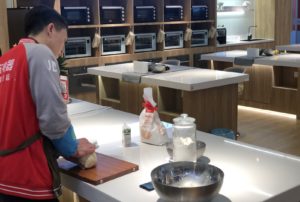
Baking experience zone in JD E-Space
Eye-Opening
But E-Space offers products at all price points. This includes a machine from Casarte, a domestic high-end Chinese brand under Haier, with a name that might confuse someone in to thinking it was in fact from Europe or elsewhere, and a price tag of over US $14,000. In China, imports continue to be welcomed by consumers, but as domestic brands not only improve in quality but also take advantage of their local expertise to customize products specifically catered to the local market, domestic brands are increasingly becoming more competitive. Take Casarte as case in point.
Not too far from the washing machines and TVs are the vacuum cleaners. Yet another product where how much one spends on the product is a mix of financial means, general interest in the product and its overall effectiveness. Where someone with a seven figure annual salary might not think twice about a vacuum that is upwards of $1,000, someone with a more moderate income might want to consider the purchase a bit more deeply. It seemed like E-Space understands this dynamic better than most. Not only are all the vacuums pre-charged and ready for a test run on the makeshift floor which combines a strip of carpet, hardwood and marble, but small canisters of different forms of dirt are placed next to each experiential station to sprinkle on the rug – the devil is in the details!
It’s now late afternoon – having go-karted, feebly made an attempt at video gaming and even given the vacuum a spin – and time to move up to the third floor. The layout is markedly different than the previous floors – the first floor being arranged by brand and product, and the second floor being arranged by product category. Instead, the third floor, arranged by brand, but with a large and varied product mix harkens back to the world famous Consumer Electronics Show (CES) held annually in Vegas in January. Apparently that’s not actually far from the truth, and in fact, exactly what the creators behind E-Space had in mind. Not only is it a place to see products on display, but for brands to showcase their latest products and give consumers a chance to buy them as soon as they hit the market.
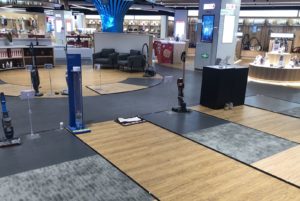
Vacuum demo zone with different types of flooring in JD E-Space
Mini-CES
E-Space, which could effectively function as Chongqing’s own “mini-CES”, takes the whole concept a step further – and not just on the third floor – because products can be taken home, rather than simply seen on display at booths like at CES. In fact, Microsoft, a long-time partner of JD.com, put their new Microsoft Surface Pro 7 launched in November 2019 and Surface Laptop 3 launched in December 2019 in JD’s E-Space.
To think about spending 8 hours in an offline store and walking over 15,000 steps in E-Space – more steps than taken in the average golf game (about 7km) – might seem surreal right now given that with the self-imposed coronavirus isolation, taking even 1,000 steps within the close quarters of a Beijing apartment seems like a stretch, and a luxury. Also, most apartment compounds don’t allow visitors these days, leaving people generally confined to their own apartments.
Other than human-to-human, social connection, what else is lacking these days that can’t be entirely resolved online? Experience. There is no doubt that online provides unprecedented convenience – no need to lug a heavy 10L jug of water up a flight of steps, or even rent a car to be able to take a newly purchased go-kart home. But offline, or more aptly, brick-and-mortar, gives modern day, busy people an opportunity to escape— to immerse themselves in Wonderland, for 30 minutes or eight hours. The real magic of E-Space is, whether it’s the father and son driving go-karts, or the group of elderly excitedly chatting in Sichuanese, or even just a passerby looking to pick up a camera tripod – there’s something for everyone.
The coronavirus will eventually pass, and E-Space is ready for when it does.
(ella@jd.com)