World Economic Forum Highlights JD’s Use of Drones in COVID-19 Fight

by Ella Kidron

An article published by the World Economic Forum’s Agenda blog featured JD’s use of drones in the COVID-19 fight. The article, “3 ways China is using drones to fight coronavirus,” focuses on how China has been piloting ways to incorporate drones into the response to the virus. It also mentions that these efforts may serve as a model for other countries.

“With the support of the local government, e-commerce company JD deployed its drone team.

The article mentions JD’s use of drones to address delivery challenges to isolated areas during the epidemic period. It writes, “With the support of the local government, e-commerce company JD deployed its drone team. That team quickly conducted ground surveys, designed flight corridors, requested airspace access permission and conducted final flight tests. In just a few days, several drone delivery corridors were put in place replacing hours-long drives with a 2 km flight that could be completed in just 10 minutes.”

JD opened a drone route to Baiyang Lake in Hebei province during the coronavirus period, completing the first delivery on Feb. 7th. Previously, couriers would deliver packages to the village by boat, but this route was temporarily suspended due to the virus. Without drones it would have required couriers to detour over 100 km to deliver via land-based routes. With JD’s drone program, the drones drop parcels at a fixed point. In this case, customers were able to pick them up without human-to-human contact, better protecting both customers and JD couriers.

JD has also used drones to spray disinfectant, helping strengthen protective measures against the coronavirus.

JD has also used drones to spray disinfectant, helping strengthen protective measures against the coronavirus. With a flight radius of 5km, using drones enables the city of Ordos, Inner Mongolia to cover a wider and more thorough area than they would be able to cover with human personnel, in a shorter period of time.


(ella@jd.com)

Third Party View: Competitors Collaborate: Gome launches flagship store on JD.com

by Jiong-jiong Yu, Senior Retail Analyst, IGD

A move underscores a shift in China’s retail industry.

Leverage each other’s strengths

Gome, China’s major brick-and-mortar retailer of home appliances and electronics, launched a third-party flagship store on JD.com last week.

Gome, with a net revenue of US$9bn in 2019, sells high end products that would be traditionally sold offline only.

This partnership sees the two parties leverage each other’s strengths. Gome can expand its customer reach by tapping into JD.com’s 360 million active annual users. It can also increase its product range through JD.com’s supply chain. JD.com will be able to enrich its offering via Gome’s large amount of high-end products that are traditionally sold offline, further enhancing its attractiveness to users.

As part of this partnership, JD will provide data, technology and customer service-related support to the Gome online store.

Competitors seeking common ground

JD.com and Guomei would be traditionally be considered competitors. The new partnership underscores a shift in China’s retail industry where competitors are finding common ground to collaborate.

Walmart is also a strategic partner of JD.com. Walmart sold its online business, Yihaodian, to JD.com in 2016 through an alliance agreement. For Walmart, the alliance greatly expands its omnichannel opportunities, enabling the one-hour home delivery service and contributing to its good performance in China.

This article originally appeared on IGD.com, here: https://retailanalysis.igd.com/news/news-article/t/competitors-collaborate-gome-launches-flagship-store-on-jdcom/i/24497

Wall Street Journal Highlights JD’s Omnichannel Fulfillment Program

by Ella Kidron

A Wall Street Journal article, “How China kept its supermarkets stocked as coronavirus raged,” published on March 13th, highlighted the role of JD’s supply chain innovation program, Omnichannel Fulfillment, in ensuring supply of necessities during COVID19. The story provides a comprehensive picture of food supply by private and public institutions during the epidemic period.

The article writes, “JD.com said that when inventories in its warehouses for products like rice, flour and oil started getting tight, it was able to source additional supplies from offline businesses – including mom and pop stores – that were open and closest to customers.” Since demand for these products is generally higher offline in normal circumstances, when the majority of people were remaining in their homes at the start of virus the outbreak, JD turned to its Omnichannel Fulfillment supply chain innovation program.

JD’s supply chain innovation program, Omnichannel Fulfillment, in ensuring supply of necessities during COVID19.

When a consumer places an order online, the platform matches the order with offline supply closest to the customer in real-time, and then arranges for a courier to deliver to the consumer among the most efficient route. Instead of relying solely on the stock in JD’s warehouses, the omnichannel fulfillment platform will calculate which brick and mortar stores nearest to the customer has the items in stock, and then source the inventory from there, both ensuring supply and delivery speed.

The article also mentions that, “Private companies, including JD.com Inc. and Walmart Inc., rerouted trucks and located supplies that otherwise might not have made it to market.” Early on in the outbreak, JD established a special channel to provide fast aid to Wuhan, the epicenter of the outbreak, from across the country. At the same time, the company relies on priority logistics channels to distribute a variety of materials. The goal is to ensure the fastest delivery of the most urgent materials while ensuring the maximum utilization of limited capacity resources. JD also implemented re-routing and inventory planning schemes to avoid goods that need to go to other regions from having to be transferred or sourced via Wuhan, reducing bottlenecks in getting emergency goods to Hubei province.

At the same time, JD launched “Mobile Fresh Basket” to provide a convenient and reliable way for people in Hubei province to get fresh produce that was already around them instead of it having to come from elsewhere. Mobile Fresh Basket sources from three channels for the produce: JD’s Friends Shop Program – a group buying mini program for communities, B2C inner city distribution of fresh products directly from wholesale markets to housing compounds, and government partnerships with agricultural enterprises. JD Logistics picks up the produce and delivers it directly to residential compounds. Following an initial launch in Hubei, Mobile Fresh Basket has expanded to over 50 cities.


(ella@jd.com)

JD’s “Online-Clubbing” Drives Liquor Sales

by Rachel Liu

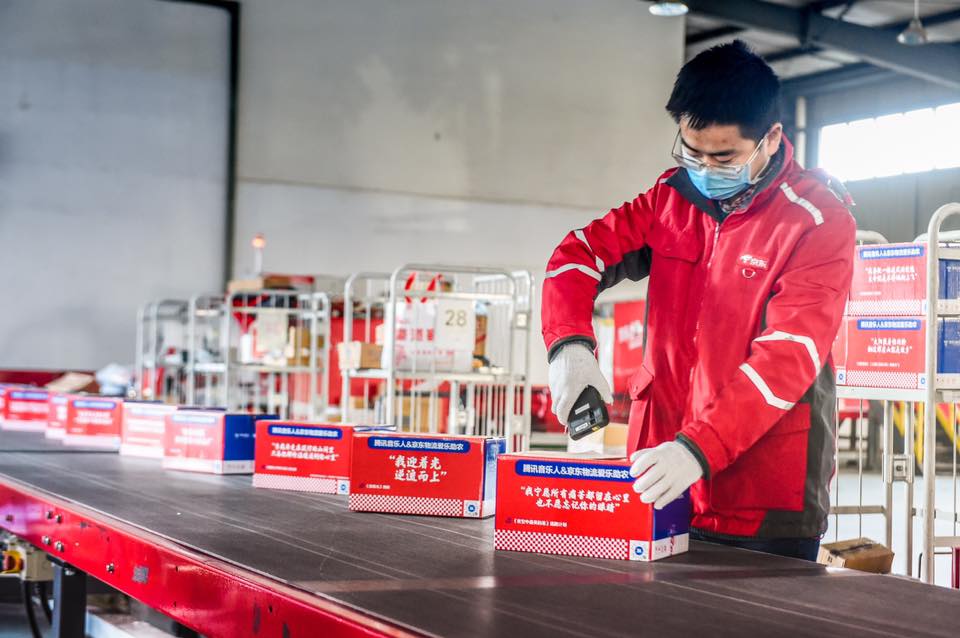
JD has teamed up with Taihe Music Group and multiple international liquor brands to bring entertainment online and drive liquor sales.

Budweiser, Rémy Martin, Carlsberg and Pernod Ricard have joined the program. It is the first time for these brands to join such a promotion, and they have seen great sales performance thus far. During one of the live shows, sales of imported liquor from a single partner brand increased 70%, and sales of its whiskey products increased 8 times compared with the same period on the day before. During another show, sales of beer increased 40% compared with the same period of the day before.

JD has teamed up with Taihe Music Group and multiple international liquor brands to bring entertainment online and drive liquor sales.

Every week, JD invites musicians and DJs from Taihe to hold a three-hour live show through JD Live, and introduce liquor products which viewers can buy with a single click. COVID-19 outbreak has caused many clubs and bars to shut down, which limits people’s choices of entertainment. As a result, “online clubbing” and “online gathering” have become popular choices for fun-seeking people, especially among youngsters at their 20s. Online versions of other traditionally offline activities such as online travel, museum visits and theater performances have also emerged.

Seeing the trend, JD decided to move the entertainment online and leverage these sessions to promote liquor products. By combining online shopping experience and entertainment, JD not only provides customers a new way to shop, but also drives sales for liquor brands which are impacted by the shutdown of offline channels.

JD will continue to leverage live broadcasts of music performance in clubs, live houses and even music festivals for products marketing, making it a long-term program to enrich customers’ shopping experience. It will also open to other categories besides liquor.


(liuchang61@jd.com)

The Economist Spotlights JD Health’s Telemedicine Efforts during COVID-19

by Hui Zhang

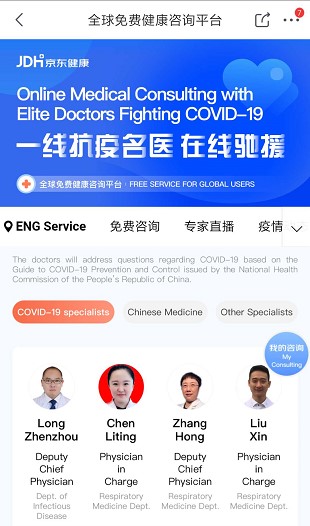
The Economist highlighted JD Health’s contribution to fight against the COVID and its irreplaceable role in the industry in the March 7th-13th, 2020 issue of the magazine. The report mentions that the novel coronavirus is boosting a fledgling industry – telemedicine – as millions of Chinese are seeking treatment and advice on the internet.

The Economist highlighted JD Health’s contribution to fight against the COVID

The story states that COVID-19, like SARS, proving a blessing for e-commerce, is also providing space for the telemedicine industry to grow. It quoted Lijun Xin, CEO of JD Health, as saying that the monthly consultations for JD’s Internet Hospital platform have grown tenfold since the outbreak, to 2 million. Some 1.6 million tuned in to a talk by a top cardiologist that the JD.com subsidiary live-streamed.

The Economist explains that at first both authorities and Chinese consumers were quite cautious towards telemedicine, and reluctant to embrace it before COVID-19. However,  COVID-19 has accelerated the shift and helped telemedicine gain trust from Chinese consumers as a result. “Without the outbreak, such a shift in consumer behavior would have taken perhaps five years,” said Xin.

The article also highlights JD Health offering free online consultations to people across China. “It makes ‘little sense’ to focus on profit at the moment. What matters is how COVID-19 has made people think twice about rushing to hospital and helped foster trust in general practitioners, who provide the bulk of online advice. It has also broadened the appeal of firms like JD Health, beyond middle-aged patients with chronic conditions to web-savvy youngsters seeking advice for parents and grandparents and healthy types simply seeking reassurance,” Xin explains in the article.

Lijun Xin, CEO of JD Health

Lijun Xin, CEO of JD Health

It also mentions that JD Health has also lured more pharmacies to its platform. A full-time doctor working for JD Health, who previously worked in an AAA hospital in Beijing, said many of her old colleagues and classmates are doing the same.

A leading weekly international news and business population, The Economist is read by more of the world’s political and business leaders than any other magazine and has 1.7 million combined circulation of printed and digital version.


(zhanghui36@jd.com)

JD Becomes World’s First E-Tailer to Supply Kiwifruit Directly from Zespri

by Yuchuan Wang

On March 16th, JD.com signed a contract with Zespri, the world’s largest marketer of kiwifruit, becoming the world’s first online retailer to supply Zespri kiwifruit from the brand directly to consumers. Given COVID-19, this contract was signed remotely online, instead of in person.

As part of the agreement, JD’s online and offline fresh food businesses, JD Fresh and 7FRESH, will procure over 1.2 million trays (3.3 kg per tray) of Zespri’s kiwifruit from New Zealand this year. With the renewed contract, Zespri’s sales on JD are expected to exceed RMB 300 million annually.

Since the launch of Zespri’s flagship store on JD in 2017, sales of the brand have increased more than 14 times. In 2019, sales of the company’s kiwifruit on JD exceeded RMB 200 million in November. Kiwifruit is especially popular with middle class consumers who are focused on health and nutrition.

“JD is Zespri’s key partner in China in brand promotion, consumer operation and lower-tier city penetration,” said Michael Jiang, General Manager of Zespri Greater China. According to JD’s data, 60% of customers of Zespri products are JD PLUS members and 75% are married. In 2019, sales of Zespri in 4th to 6th tier cities increased 46% year-on-year.

This year’s first Zespri kiwifruit harvest will begin selling on JD in April. The brand’s premium SunGold kiwifruit will launch pre-order across JD’s online platform and offline supermarkets on March 23rd.

As Chinese consumers are increasingly buying fresh food online, JD has leveraged its “new infrastructure”, including digital supply chain and cold-chain logistics expertise to source globally. The success of this has been proven during COVID-19. From January 20th to February 18th, JD Fresh sold over 88,000 tons of fresh produce to nationwide customers.


(yuchuan.wang@jd.com)

PYMNTS.com Features How JD’s Idea of Chatbot Services Customers Smartly

by Yuchuan Wang

A feature story about JD was posted on PYMNTS.com, the top site for the payments industry which covers news related to payments, commerce, and connectivity, on March 13th.

The article is titled “How JD.com Uses AI To Connect Consumers With Commerce” and is based on an interview between PYMNTS’ founder Karen Webster and Dr. Xiaodong He, deputy managing director of JD AI Research and head of the Deep Learning, NLP and Speech Lab at JD.com.

The article mainly highlights JD’s efforts in smart customer service which is powered by AI. “From a baseline of better connectedness, JD.com has been able to build AI that doesn’t just understand customers’ questions well enough to give them right answers. It understands them well enough to respond to their feelings — and curate the content they see.”

A feature story about JD was posted on PYMNTS.com

Dr. He explained the thinking behind the technology: “With our idea of empathic chatbots, we want it to be that requests made in text or by voice, we definitely provide the answer, but we also try to give some empathetic response.” With multimodal chat interface, JD’s smart customer service chatbot is able to detect the subtlest human emotions and interact appropriately. It has already helped JD improve the user satisfaction by 57 percent.

The article also highlights JD’s efforts in “curating consumers’ desires”. Apart from JD’s visual search technology SnapShop which “is an arena where a single snapped image can be fed by a customer into the system to have it run through the whole system against the entire inventory catalog at JD to find a match”, JD’s team is also working on a project called “Alpha Sale” which provides “a digital sales agent that acts like a personalized assistant to help every single customer, and to help every single product.”

JD’s team is also working on a project called “Alpha Sale” which provides “a digital sales agent that acts like a personalized assistant to help every single customer, and to help every single product.”Dr. He says, “It’s a big job and not an easy project, but among the benefits of having a fully-connected, fully-integrated eCommerce ecosystem that flows between online and offline transitions as a baked-in component is that it isn’t an impossible goal either.”

He goes on to mention: “AI itself is probably not the magic tool to make a big change in the experience that it can be made out to be. There’s some basic infrastructure that has to lie underneath it, and some pretty advanced connections actually, which is actually very important.”

Based in the US, PYMNTS is the No.1 site for the payments industry by traffic and the premier source of information about “what’s next” in payments and commerce.


(yuchuan.wang@jd.com)

In-Depth Report: How JD Tackles Counterfeits

by Brad Burgess

“JD leaps to a 20-month high after sales outlook quells virus fears.” Such is the headline from Bloomberg as I write this, referring to the surprising business results that JD.com achieved and disclosed during the company’s most recent earnings call on March 2nd.

Some investment analysts also mention in their post-earnings notes how impressive JD’s new customer acquisition is at 28 million for Q4 2019, 70% derived from China’s lower tier cities and much higher than peer companies.

While JD’s fundamentals seek to be a guarantor of quality and authenticity, it’s worth taking a look at how the company goes about it.


One Strike And You’re Out”

JD maintains that one of the most important reasons for its rapid and healthy development over the years is rooted in the belief of right success, strengthening platform rules and technology, and effectively protecting trademarks and intellectual property rights. In so doing, JD can establish a positive ecosystem, creating a virtuous cycle. The focus has always been on quality. From designing the business model to outlining the playbook and rules for JD’s platform operations, this ecosystem “encourages the good, and repels the bad”. This includes directly cooperating with brand merchants, upholding business integrity and protecting IP rights.

At the same time, JD believes that advanced prevention is much more effective than dealing with difficulty after the fact. JD’s attitude toward fakes and shoddy products is absolutely “zero tolerance”. Systemically, the company’s approach for intellectual property protection is to develop robust prevention as a precedent and modus operandi for the business. For JD’s platform business, there is a preference for “strict management” over “broad management”. JD would rather give up the advertising revenue that recruiting a large number of merchants may deliver in favor of monitoring all aspects of operations and guarding against infringement to the greatest extent in exchange for its obligation to be responsible to customers.

“One strike and you’re out” is an important principle. This is how JD severely punishes merchants that are selling products that infringe. Once illegal activity is confirmed, JD will act by imposing severe punishment on the offender, acting according to the contract terms, removing and blacklisting them at the same time.

As for marketing and advertising, JD.com commits to provide authentic and accurate information about its products and services; rejects exaggerations about the social and environmental impacts of the company’s products and services; protects vulnerable market segments, especially those who have difficulty in obtaining sales information including children, seniors and those with disabilities. It is also not acceptable to defame competitors. The company’s concept of “achieving success the right way” requires obeying laws, regulations and industry norms to build a fair and healthy business environment.

“One strike and you’re out” is an important principle.


Proof of the Pudding

Part one in this series introduced how JD’s business model creates a unique customer experience that Chinese consumers have come to trust. The customer growth mentioned above linked with a new consumer cohort is further proof of the pudding.

It’s important to understand that the most significant guarantor of authenticity at JD.com is this very business model. I wrote about this here. To recap the key points, JD’s core business that makes it unique from others is its first party business, which is what Chinese have come to know JD for. This is why JD is foremost a retail company primarily rather than a marketplace. A fundamental aspect of this model is JD’s ability to choose large (and – by extension – reputable) suppliers. These products also enter JD’s own self-built warehouses, which are outfitted at each step of the way throughout the supply chain with technology that inspects the quality of the goods to be in inventoried. At the same time, more and more third-party businesses are also using JD’s warehousing and distribution services and accepting JD’s inspection and supervision.

Fully managing the supply chain from the starting point to the last mile is the primary way to guarantee quality and is unique from other e-commerce companies. It is also the foundation and premise of strict quality control.

JD’s supply chain is as rigorous as it is efficientJD’s supply chain is as rigorous as it is efficient

This is quality control at the business system level. This point cannot be overlooked. And, it’s this very system that enables strict oversight.

Additionally, it’s worth noting that more and more merchants on JD’s third party marketplace platform are using JD Logistics for their supply chain solutions, which leads to greater control over the process. Thus, JD’s third party marketplace model is also stronger than that of the competition.


A Rigorous Quality Control System

JD has established a highly rigorous quality control system to ensure the quality of the goods sold, with strict standards applied.

Guaranteeing authenticity is a multi-stakeholder approach. Internally, JD has established a quality control team which is composed of corporate-level quality control and sub-teams across business departments. This team works closely with people responsible for supplier qualification review and daily supervision.

JD’s authenticity guarantee starts with a strict entry threshold. For all merchants in JD Retail, JD has a strict entry qualification audit to protect access. 100% of key categories require brand manufacturers to authorize and endorse the merchants, requiring those merchants to sign a quality commitment letter and pay a quality deposit. JD’s dedicated quality control department reviews all qualification documents, brand authorizations, trademarks, and others and strictly controls all links to avoid suspect merchants or products from entering the platform. Merchants must also meet a series of strict requirements upon entry, among which the most basic is to ensure authenticity. This process is not only document review, but also random inspection of products and factory inspection.

After business commences, JD continues to conduct strict monitoring on merchants and products. There are three approaches engaged for this purpose: active inspection, mystery shopping, and a points management system.

Active inspection refers to JD screening products and publicity on the platform through a quality management system. Mystery shopping is when JD entrusts renown global inspection and testing companies to purchase products sold by JD anonymously to send to brand owners and to labs for verification, dealing with issues if discovered.

Organizations like Intertek and CCIC will assist JD in conducting regular spot checks on almost all categories of products to better control product quality.

A “points management system” is an effective tool for JD to regulate merchant’s operational behavior. If merchants violate the rules, JD will deduct points according to the severity of their actions. Different points correspond to different punishments, such as removing goods off the shelf, store reduction, closure, etc.

Externally, JD also interacts closely with brands themselves to share information. To work in an environment of mutual trust and transparency, JD actively cooperates with brand owners and numerous brand protection organizations. At present, there are over 1,000 brands and brand protection organizations that have established IP protection cooperation with JD. Some of these include CAASA, QBPC, CBBC, JETRO, KOTRA and other well-known intellectual property protection organizations within China and from around the world that JD closely collaborates with.

Communicating with Chinese government departments is also important to stay informed with any issues which may arise.

A member of JD’s quality control teamA member of JD’s quality control team

“Peace of Mind Purchase”
With the growth of China’s middle class and an overall preference for trading up for higher quality branded goods across China, cross-border e-commerce shopping has become increasingly common. However, this opportunity also brings challenges. For example, how to distinguish quality goods, navigate sometimes opaque information about the circulation of goods, deal with slower logistics, and handle the difficulty of return and exchange can all be confusing. How to not only reduce confusion – but to succeed in such a challenging environment?

In July 2018, as one of the largest cross-border e-commerce platforms in China, JD Worldwide launched 35 “peace of mind purchase” initiatives to guarantee product quality and improve the overall customer experience.

JD Worldwide launched 35 “peace of mind purchase” initiatives to guarantee product quality and improve the overall customer experience.

These initiatives are split into quality control and after-sales service. In sum, there are six pre-sales quality control measures, seven during the sales process and twenty-two after sales. The 35 initiatives are up to date, and JD hopes to improve the user experience overall through this. Given available public and industry information, JD’s approach here is a best practice for the industry. JD is committed to building the most comprehensive and reliable cross-border e-commerce platform for top brands from across the world, and improving on the customer experience.

JD’s tagline on its website is “Authentic products. Delivered today.” One of the company’s six core values is Integrity (诚信). These are intimately linked to the company’s commitment to quality and authenticity.

JD’s supervision and oversight on authenticity is consistently strict and sophisticated. If there are ever any tips about quality issues as it relates to JD, the company welcomes people to reach out to service@jd.com.

This is just an overview of what JD does to guarantee quality. It happens foremost at the system level. It’s also through a rigorous process and strictly managed oversight that the company is able deliver on its brand promise.


*”How JD tackles counterfeits” is a three-part series that tells JD.com’s story. Part one introduced how JD’s beginnings and business model guarantee authenticity. Next, part three will introduce some of the technology behind JD’s quality control.

(Part 2 of 3)


Read Part 1: LINK


(brad@jd.com)